 |
 |
 |
|
|||||||||
|
||||||||||||


|
|
|||||||||||||||||
|
||||||||||||||||||
|
|||
|
|||
|
|||
|
| Neuroscience Apoptosis & Cancer Growth Factors and Cytokines Endocrinology Transcription Factors Cell Biology Cell Stress Adhesion, Matrix & Structural Genome Loci Microbiology Plants Miscellaneous |
GeneDetect® oligonucleotide
gene probes.
Click on one of the categories to your left to BROWSE or click on the search button on the Navigation Bar to SEARCH for a specific probe among the more than 4000 scientifically validated gene probes available from GeneDetect. Introduction "Gene Probe: A piece of DNA that binds specifically to a particular gene or part of a gene" In measuring tissue gene expression, independent of the technique used, the sequence of the gene probe must be complementary to the nucleotide bases of the specific mRNA or DNA sequence of interest. Gene probes can be as small as 20-40 base pairs or be up to 1000bp long. GeneDetect® oligonucleotide gene probes are produced synthetically by an automated chemical synthesis using sequences derived from the GeneDetect® oligonucleotide probe database and are usually 40-50 nucleotides long. The majority of our probes are validated by prior publication in the scientific literature. Each online product description contains a link to published article(s) in PubMed/Medline that have used and characterized the probe. Dear GeneDetect,
Uses of GeneDetect® oligonucleotide gene probes GeneDetect® oligonucleotide gene probes can be used in any of the following techniques. In situ hybridization
When you purchase a standard probe pack you
are A standard GeneDetect®
oligonucleotide gene probe pack contains THREE oligonucleotides: You also receive full probe sequence information in the Product Specification Sheet, copies of up to three journal articles that have characterized and used the probe, protocols and relevant GenBank FASTA/BLAST printouts showing target specificity. You are also eligible for full technical support from our resident expert scientists via email to Scientific@GeneDetect.com to ensure successful use of the probe within your experiments. All technical support questions are answered within 24 hours. Dear GeneDetect,
In addition to supplying GeneDetect® oligonucleotide probes unlabeled, we can supply probes 5' labeled with one molecule of either biotin, FITC or rhodamine. You will need to specify the labeling required when making your order. GreenStar*TM hyperlabeled probes are optimized for use with in situ hybridization. GreenStar*TM hyperlabeled probes have 10 x label molecules added to the 3' end for enhanced sensitivity. 10 molecules of either biotin, FITC, rhodamine or digoxigenin (DIG)§ are attached to the 3' end of the probe. These labels are optimally spaced for enhanced detection of the probe using standard methods. Dear GeneDetect,
On request we are also able to add to your
GeneDetect® probe(s) the 3' TTTTTCg linker enabling
oligonucleotide labeling with direct fluorescent 3DNA StarfishTM
technology. StarfishTM is a trademark of Genisphere Inc,
www.Genisphere.com. In this case you will also need to purchase the probe
labeling kit from Genisphere Inc.
All prices are in US dollars. Shipping costs are not included in these prices. Prices are subject to change. Please add $139 per probe pack if you wish to have a custom probe prepared.
We run various discounts, promotions and sales throughout the year. To see what is currently available for you to take advantage of click here or here. Which labeling method is best for your application? The type of labeled probe you choose will depend upon the final use you have in mind for your probe. The following table summarizes the different types of labeled probes available and their suitability for various applications.
Storage Standard lyophilized oligonucleotides are stable for many years if they are stored frozen at -20°C. When in solution however, to prolong shelf life the oligonucleotide should be kept frozen at -20°C preferably as a "stock solution" with a final concentration not much less than 15m M (~ 200ng/ul of a 48mer probe) in TE buffer (Tris-EDTA 10 mM, 1mM) buffer at pH 7.5-8.0. A slightly alkaline buffer prevents possible depurination of the oligonucleotide. In an acid buffer A and G bases are eliminated, leading to oligonucleotide damage. While TE buffer is the preferred solution for oligonucleotide storage it is not necessarily the best solution for oligonucleotide use. TE buffer may interfere with various enzyme dependent reactions so the required amount of oligonucleotide probe should be removed from the stock solution and diluted in nuclease free distilled water for labeling or other procedures. While oligonucleotides are very stable they are prone to BACTERIAL attack. Use autoclaved tips and tubes. Storage versus (stability) Dissolved at 25C (1 week to 3 months) 5' or 3' labeled oligonucleotide probes should be kept away from air. Making sure the aliquot tube screw cap is on properly and that tubes are kept in properly closed ziplock bags should suffice. Fluorescent-labeled probes (FITC and rhodamine) should be shielded from light to prevent bleaching. Cover the tube in aluminum foil. Repeated freeze-thawing can dramatically
lower the shelf life of an oligonucleotide. Handling When you receive your GeneDetect® oligonucleotide gene probe it may be difficult to see the lyophilized oligonucleotide at the bottom of the tube. To resuspend the oligonucleotide please follow this procedure in a step wise fashion.
The GeneDetect® oligonucleotide probe database The GeneDetect® oligonucleotide probe database was created several years ago and is continually being updated. Presently it holds the "corrected" nucleotide sequences of over 4000 oligonucleotide gene probes referenced in peer-reviewed scientific journals to successfully detect tissue gene expression. Increasingly the sequences of proprietary probes designed in-house are being added to this database. Significantly, the sequences of all entries derived from the scientific literature are checked by our staff prior to inclusion since we have found a sequence error rate of approximately 4% in these sequences. Limited access to this database is provided free via this website.
Specific sequence information is available from this database. Please contact us for pricing via Sales@GeneDetect.com §The use of digoxigenin technology to label nucleic acids is licensed under patents (EP 0 324 474, US 5.344.757, US 5.702.888, US 5.354.657, JP 1999884 and HK 1169) owned by Roche Diagnostics GmbH. For further information on products to label and detect digoxigenin-modified nucleic acids refer to www.roche-applied-science.com/dig/
|
|
|
|
|
|
|


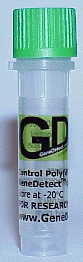 GeneDetect® oligonucleotide
gene probes are supplied lyophilized with 2500 pmoles (~35ug) of unlabeled
probe per vial. All probes
are cartridge purified to ensure product supplied is >95% full length
meaning that you do not get a random mixture of half synthesized probes that could lead to increased background
staining or cross hybridization to non-targeted genes.
Probes are also available labeled with either biotin, FITC, rhodamine or
digoxigenin (DIG, Licensed from Roche Diagnostics GmbH)§.
GeneDetect® oligonucleotide
gene probes are supplied lyophilized with 2500 pmoles (~35ug) of unlabeled
probe per vial. All probes
are cartridge purified to ensure product supplied is >95% full length
meaning that you do not get a random mixture of half synthesized probes that could lead to increased background
staining or cross hybridization to non-targeted genes.
Probes are also available labeled with either biotin, FITC, rhodamine or
digoxigenin (DIG, Licensed from Roche Diagnostics GmbH)§. supplied with three single-stranded GeneDetect®
oligonucleotide gene probes (labeled or unlabeled) in sufficient
quantities that allow for many hybridization experiments to be performed.
The figure to the right shows the typical purity obtained by
cartridge-purifying your GeneDetect probes. Cartridge purification works
well over a wide range of probes lengths.
supplied with three single-stranded GeneDetect®
oligonucleotide gene probes (labeled or unlabeled) in sufficient
quantities that allow for many hybridization experiments to be performed.
The figure to the right shows the typical purity obtained by
cartridge-purifying your GeneDetect probes. Cartridge purification works
well over a wide range of probes lengths.